The claim contains a real finding, but the headline outruns it
The appealing version of the story is that raccoons in Canadian cities are “domesticating themselves”: becoming cuter, calmer and more companionable in exchange for easy food and shelter, much as the ancestors of dogs or cats moved into the human orbit. There is now a genuine scientific result behind that claim, but it is much narrower than the viral formulation suggests.
A 2025 paper in Frontiers in Zoology reported that raccoons photographed in urban parts of the contiguous United States had, on average, a slightly shorter snout relative to skull depth than animals photographed in rural areas. In the authors’ reduced model, covering photographs from 2020 to 2024, the estimated difference was 3.56 per cent after accounting for climate.
That is an interesting association and a plausible prompt for further research. It is not evidence that an urban raccoon is domesticated, that the difference is inherited, or that raccoons have embarked on a one-way evolutionary journey towards becoming pets. Nor, despite some Canadian reporting, did the study analyse a Canadian sample. Its observations came from the contiguous United States.
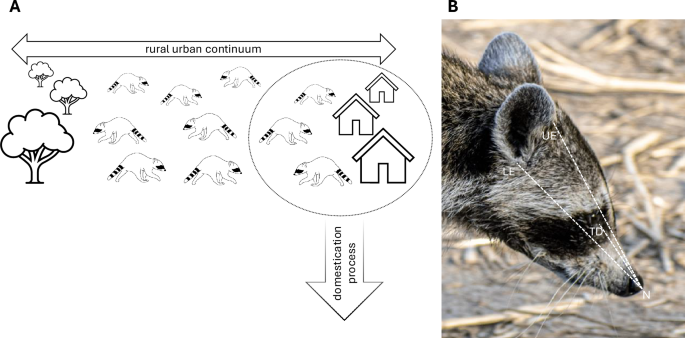
What the researchers actually measured
The project began with 105,722 raccoon images uploaded to the citizen-science platform iNaturalist. The researchers reduced this to observations from 19,495 unique contributors to avoid repeatedly sampling the same photographer, then imposed strict requirements: an animal had to present a usable side profile, with landmarks that allowed the face to be measured. Only 249 photographs survived those filters—211 urban and 38 rural. The reduced 2020–2024 analysis contained 172 images.
The measured quantity was not absolute nose length. It was a ratio: the distance from the eye to the tip of the nose divided by a measure of skull depth. Urban animals had a smaller mean ratio. That pattern is consistent with a shorter muzzle, but the study did not identify the animals’ ages or sexes, follow family lines, sequence their genomes, measure hormones, test tameness, or show that short-snouted individuals produced more surviving offspring in cities.
The finding is therefore best described as a possible signal of selection associated with urban life. It may also reflect other influences, including developmental conditions, diet, demographic differences or sampling. The authors acknowledge the need for field studies, museum specimens and genetic work.
Why “domestication syndrome” entered the story
Many domesticated mammals differ from their wild relatives in recurring ways: reduced muzzle or tooth size, altered reproductive cycles, changes in stress responses, floppy ears and patches of depigmented fur are often included in the list. One influential explanation proposes that selection for reduced fear or aggression subtly changes the development of neural crest cells, which contribute to the skull, pigment cells, adrenal glands and other tissues.
Under that hypothesis, animals which tolerate people may gain more access to food and shelter. If the biological changes associated with lower reactivity also affect facial shape, a shorter muzzle could appear before deliberate breeding begins. The raccoon paper asks whether cities might create the first stage of such a process.
However, the “neural crest domestication syndrome” is a debated hypothesis, not an established universal law. A 2021 review argued that no single neural-crest mechanism adequately explains the diversity of changes across domesticated species. Different traits can have different genetic and developmental causes, and not every domestic animal displays the full package.
More importantly, the raccoon study measured only facial proportions. It did not find a shift in coat colour, loss of the dark eye mask, paler fur, white patches or floppier ears.
What the facial and colour comparison really shows
The two photographs below illustrate animals in human-dominated and more natural surroundings. They are useful examples of context, not diagnostic portraits of a domestic and a wild type. Both remain wild Procyon lotor, and both retain familiar raccoon markings: grey-brown grizzled fur, a dark eye mask bordered by paler fur, and—when visible—a ringed tail.


| Feature | Urban raccoons in the study | Rural raccoons in the study | What can be concluded? |
|---|---|---|---|
| Snout proportion | Smaller mean snout-to-skull ratio | Larger mean ratio | A modest population-level association; not a way to classify an individual |
| Dark eye mask | Not tested as an urban difference | Not tested as a rural difference | No demonstrated domestication signal |
| Coat colour or white patches | Not measured | Not measured | No evidence in this study that urban raccoons are becoming paler or piebald |
| Tameness | Not measured | Not measured | Habituation to people cannot be equated with inherited docility |
A pale, albino, leucistic or unusually marked raccoon would therefore be a pigmentation variant, not visual proof of domestication. Domestic lineages can accumulate colour variants because humans protect and breed them, but unusual colour on a wild individual does not reveal the process that produced it. There is presently no accepted “urban domestic” facial or colour morph against which a Canadian raccoon can be identified.
Urban adaptation is real; domestication is a much stronger claim
Raccoons thrive in cities because they are flexible omnivores, capable climbers and dexterous investigators. Buildings provide den sites; gardens, rubbish, compost, pet food and deliberate feeding provide calories; and large predators are often less common. Individuals can learn that people and human structures offer opportunities. Populations can also change over generations if urban conditions consistently favour particular inherited traits.
Those processes should be kept distinct. Habituation is a reduction in response after repeated harmless exposure, such as an individual ceasing to flee from pedestrians. Behavioural flexibility is the ability to solve new problems or switch strategies. Urban adaptation may involve learned and inherited responses that improve survival in towns. Domestication is a population-level evolutionary process produced by sustained selection in association with humans, normally across many generations. Taming is what happens to an individual; domestication happens to a lineage.
Experiments support the picture of raccoons as capable, highly individual problem-solvers. In one study of wild raccoons, eight of 35 animals solved a single-solution puzzle and seven of 31 solved a multi-solution problem, with marked differences between individuals. A 2026 University of British Columbia study reported that wild raccoons sometimes continued interacting with puzzle devices even after food rewards were no longer available. Intelligence and curiosity help explain why raccoons exploit cities, but neither trait amounts to domestication.
Are they the next cat?
Probably not, at least on any human timescale supported by current evidence. Cats entered a long association with farming settlements, where rodents created a niche for predators that people tolerated and eventually transported and bred. Modern cats descend from populations that passed through many generations of selection around humans.
Urban raccoons do receive benefits from proximity to people, but the relationship is largely one of opportunistic scavenging and conflict management. Humans generally try to exclude them from roofs, bins and crawl spaces rather than encourage them to reproduce indoors. There is no broad, stable breeding population being selected for companionable behaviour, and no evidence that a new domestic raccoon lineage has formed.
A better comparison is synurbisation: wild animals adjusting to urban ecosystems. Foxes, coyotes, pigeons, gulls and many other species do this without becoming domestic. Raccoons may be changing in cities, and the reported muzzle difference makes the evolutionary question worth investigating, but “the next cat” remains speculation.
What keeping a raccoon would actually involve
Even leaving law aside, a raccoon is a demanding captive wild animal rather than an unusual version of a cat. Its most attractive characteristics—manual dexterity, persistence, curiosity and problem-solving—are precisely what make ordinary domestic accommodation unsuitable.
Containment would need to resemble a zoo enclosure. Professional guidance for procyonids recommends a fully enclosed, lockable structure with considerable floor area and usable height, climbing routes, nest boxes, visual barriers, secure roof and protection against digging. Raccoons can manipulate simple latches, climb wire, squeeze through defects and investigate weak points repeatedly. Double-door access and keyed or padlocked closures are prudent. An ordinary cage, spare room or garden shed is not adequate.
The enclosure would need water and constant behavioural work. Raccoons explore with their forepaws, forage, climb, tear and wash or manipulate objects. They need varied substrates, branches and platforms, hiding places, puzzle feeding, destructible items and regularly changed scent and food-based enrichment. A shallow pool or robust water provision adds behavioural opportunity but also creates a daily cleaning problem.
A house would have to be raccoon-proofed beyond child-proofing. Cupboards, food stores, bins, appliances, plumbing, cables, soft furnishings and doors would all be targets. Their nocturnal activity conflicts with human sleep. Scent marking, latrine use and seasonal changes in behaviour make reliable house training unlikely. A sexually mature animal can bite or scratch with little warning, particularly when frustrated, frightened, guarding food or resisting restraint.
Social needs are not solved simply by buying two. Raccoon social behaviour varies with age, sex, season, resources and individual history. Compatible animals may benefit from company, while incompatible animals may require separation. That means space for multiple enclosures and safe introductions, not merely a larger shared cage. Human attention is not a substitute for species-appropriate conditions.
Feeding requires more than scraps. A varied, balanced omnivorous diet must supply appropriate protein, micronutrients and fibre without providing the energy surplus that leads easily to obesity. Foraging should occupy time and effort. Unlimited pet food, leftovers and sweet fruit may be convenient but can create serious nutritional and weight problems.
Veterinary care is a specialist requirement. A willing exotic-animal vet should be arranged before acquisition, not after an emergency. Safe examination may require trained handling, a squeeze facility or sedation. Vaccination and parasite-control decisions need professional advice because products and schedules used for dogs and cats may not be licensed or validated for raccoons.
Zoonotic risk is substantial. Raccoons can carry rabies in regions where it circulates, and their faeces can contain eggs of the roundworm Baylisascaris procyonis. The eggs become infective in the environment and can persist; human infection is uncommon but can cause severe neural or ocular disease. Latrine material therefore needs strict hygiene, protective equipment and a disposal protocol. Children and vulnerable adults should not have access to the enclosure or contaminated ground.
There must be a lifetime and escape plan. A hand-reared animal that becomes unmanageable cannot simply be released. It may lack suitable survival behaviour, transmit disease, conflict with people or establish an invasive population outside its native range. A keeper would need named backup carers, a transport method, isolation space, emergency capture equipment and a destination willing and authorised to accept the animal. Boats and other confined mobile homes are particularly unsuitable: there is too little separation, an abundance of vulnerable wiring and fittings, and an escape could place wildlife at risk.
The sober verdict
The Canadian “self-domestication” story is not pure urban legend. It grew from a peer-reviewed result that urban American raccoons in a restricted photographic sample had slightly shorter relative snouts than rural animals. The result is compatible with one predicted feature of domestication syndrome and is worth testing properly.
Everything beyond that remains open. The study did not demonstrate Canadian change, inherited docility, altered colour markings or a domestic lineage. The evidence presently supports an adaptable wild mammal flourishing in human-made habitats. It does not yet support a new companion animal emerging from the bins.
Legal position
In Canada, wildlife possession rules differ by province, territory and municipality, so legality cannot be inferred from the animal’s local abundance. For a British reader, the practical answer is firmer: in England the raccoon is listed as an invasive alien species of special concern under the Invasive Alien Species (Enforcement and Permitting) Order 2019. Subject to narrow transitional provisions for animals already kept before the restrictions, acquiring, breeding, selling, exchanging or releasing a raccoon is prohibited without the relevant authorisation. Anyone contemplating captivity must obtain written advice from the responsible wildlife authority and local council before taking possession; the husbandry obstacles described above remain even where a permit or exception exists.